Welcome to our opinion section, where Florence, coordinator at URelles, takes a step back from our daily work in diversity, equity and inclusion (DEI) to share her thoughts, favorites, and current observations from the field.
I’ll be honest from the outset: until very recently, I had never heard the term “digitalblackface.” And yet, I am a Gen Z, chronically online, a DEI consultant, the kind of person who falls down educational rabbit holes at 11 p.m. on a Tuesday night just “to understand one more concept.” So when I discovered this term, I figured that if I had never heard of this concept, there’s a very good chance that many other people haven’t either. I’m not wrong, am I?
As part of Black History Month, I wanted to take this opportunity to explain what digital blackface is, why it is not harmless, and, above all, how it fits into broader dynamics of appropriation and stereotypes.
What is digital blackface?
Digital blackface refers to the use by non-Black people (most often white people) of images, GIFs, memes, or videos featuring Black people to express strong or exaggerated emotions online. Explosive anger, overwhelming enthusiasm, well-placed sarcasm, intense fatigue, spectacular joy: these emotions are very often embodied by Black bodies in our online communications.
This phenomenon can be found absolutely everywhere! Whether it’s in Instagram stories, TikTok comments, GIFs sent on Slack or Teams, slightly “funky” internal presentations, or text messages between colleagues or friends. And most of the time, it’s probably done without any bad intentions. People who use them would most likely argue that they are more expressive, funnier, and livelier. That’s precisely why it’s important to name the concept.
Examples that may seem (a little too) familiar to you
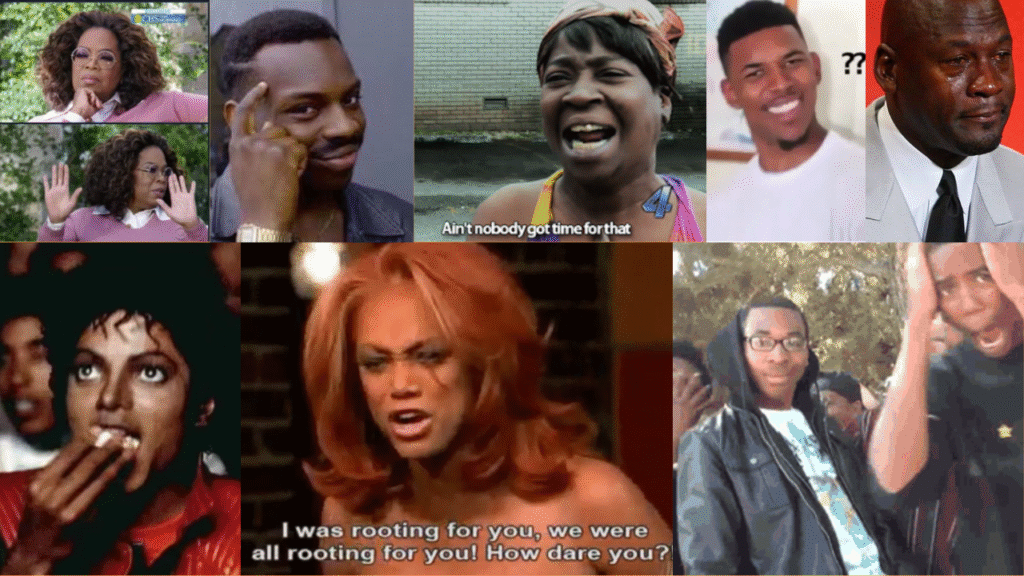
Let’s be honest: you probably already had some images in mind, but for those less familiar with the subject, here are some of the best-known examples:
Oprah Winfrey, whose facial expressions have become universal reactions. Michael Jackson used to comment on the drama unfolding. Tyra Banks uttering her legendary “I was rooting for you,” a testament to great disappointment. These images have been circulating for years.
Talking about digital blackface is not an exaggeration.
I understand very well the discomfort that the word can cause. It is heavy, loaded, uncomfortable. And it is so for good reason.
Historically, blackface refers to deeply racist practices in which white people wear makeup to caricature black people, exaggerating their features and reducing them to ridiculous and dehumanized roles. Digital blackface is obviously not exactly the same thing, but it’s not far off. The underlying logic is similar: black images, expressions, and emotions are used as tools for entertainment or emotional amplification. They are used to say “I’m shocked,” “I’m silently judging,” “I’m fed up,” “I’m entertained,” “I can’t take it anymore.”
The problem lies in the fact that these Black people are anonymized by the meme. They are no longer themselves; they are being exploited for a utilitarian purpose: to express an emotion for our digital subscribers. Their individuality is being stripped away to turn them into a joke! The image is taken out of its original context, where their experiences, voices, and intentions disappear in favor of an often caricatured emotion. Black people become the faces of drama, excess, and punchlines. This use reinforces a stereotype…
The problem isn’t laughing at or sharing this kind of meme a few times, but ignoring its significance and the fact that it’s not just a trend. This isn’t an isolated case; it’s a trend that perpetuates a caricature.
What it perpetuates, even when we “didn’t mean anything by it”
The problem with digital blackface isn’t the intention. It’s the impact.
By repeating these practices, we reinforce stereotypes that are already deeply ingrained. Black people are supposedly more aggressive, louder, more intense, funnier, and more dramatic. These are clichés that, outside of the internet, have very real consequences.
In the workplace, for example, these stereotypes can lead to Black people being perceived as less professional, overly emotional, or intimidating when they are simply expressing perfectly normal reactions. While some may use these images to laugh or vent, others pay the price on a daily basis.
Why does this directly concern us as white people? Because these practices are part of very real power dynamics. White people can borrow, use, and perform Black expressions, then return to a socially secure position. Black people do not have that option.
Recognizing this does not mean beating yourself up or declaring yourself a “bad person.” It simply means accepting that our digital actions, however mundane, have an impact.
In conclusion (promise, no moral at the end)
I am writing this article not because I am the embodiment of virtue. Quite the contrary! It is because I, too, need to learn, deconstruct, and ask myself uncomfortable questions.
In DEI, learning rarely begins with certainty. It much more often begins with a “wow… I never saw it that way.” And that’s exactly the kind of moment I hope to inspire here.
Digital blackface is sometimes difficult to identify because it is deeply ingrained in our online habits, but putting a name to it allows us to slow down, reflect, and make more conscious choices.
As part of Black History Month, this is an opportunity to consider how Black culture is consumed, transformed, and sometimes decontextualized, even in spaces that are considered innocuous.
And if this article makes you say, “OK… I’ll think about my next GIFs,” honestly, that will already be a lot.
Would you like to take your thinking further?
For organizations that want to go further, URelles offers a variety of training courses to raise awareness among your teams!
Our training courses are dynamic and participatory. We share lots of examples and tools so that you leave feeling thoroughly satisfied.
Interested by building up inclusive cultures? URelles offers the following services:
Pour offrir les meilleures expériences, nous utilisons des technologies telles que les cookies pour stocker et/ou accéder aux informations des appareils. Le fait de consentir à ces technologies nous permettra de traiter des données telles que le comportement de navigation ou les ID uniques sur ce site. Le fait de ne pas consentir ou de retirer son consentement peut avoir un effet négatif sur certaines caractéristiques et fonctions.
Fonctionnel
Always active
L’accès ou le stockage technique est strictement nécessaire dans la finalité d’intérêt légitime de permettre l’utilisation d’un service spécifique explicitement demandé par l’abonné ou l’utilisateur, ou dans le seul but d’effectuer la transmission d’une communication sur un réseau de communications électroniques.
Préférences
L’accès ou le stockage technique est nécessaire dans la finalité d’intérêt légitime de stocker des préférences qui ne sont pas demandées par l’abonné ou l’internaute.
Statistiques
Le stockage ou l’accès technique qui est utilisé exclusivement à des fins statistiques.Le stockage ou l’accès technique qui est utilisé exclusivement dans des finalités statistiques anonymes. En l’absence d’une assignation à comparaître, d’une conformité volontaire de la part de votre fournisseur d’accès à internet ou d’enregistrements supplémentaires provenant d’une tierce partie, les informations stockées ou extraites à cette seule fin ne peuvent généralement pas être utilisées pour vous identifier.
Marketing
L’accès ou le stockage technique est nécessaire pour créer des profils d’internautes afin d’envoyer des publicités, ou pour suivre l’utilisateur sur un site web ou sur plusieurs sites web ayant des finalités marketing similaires.