To read more on this topic:
Can you say “Miss”?
Using the pronoun “she” and the female gender
Can you say “female”?
Would you like to start a conversation about inclusive language in your organization? URelles can help you with this process! Find out our training courses on various topics related to equity, diversity, and inclusion.
****
When we want to talk about men, we have several options: guy, man, bro, dude, etc. The vocabulary for referring to them is varied, especially if we’re willing to use informal language. But not all these words convey the same implicit messages. Some evoke responsibility, maturity, strength, respect, and even power, while others are more neutral! The word we choose helps shape men’s place in our society and the value we assign to them. Here’s why.
| A quick reminder: Appearance doesn’t determine gender Clothing, voice, hairstyle, or physical features don’t tell you whether someone is a woman, a girl, a guy, a man, a non-binary person, or something else. If this topic interests you, we discuss it in more detail in our very first “Can you say…?” post dedicated to this question! |
Boy and man
As we saw in a previous article, the terms “woman” and “girl” are used to refer to the female gender, associated respectively with maturity and youth. Theoretically, we could therefore apply the same logic to “boy” and “man.” According to this simple distinction: a guy is someone under 18, and a man is an adult. But in practice, usage isn’t always so clear.
On the one hand, referring to a minor as a “man” can attribute qualities of maturity or responsibility to him that he does not yet possess. This is what we see in certain cases, such as in the media or police reports, where this language contributes to what is known as the adultification of boys, particularly those from racialized communities, who are perceived as more threatening or responsible than they actually are. The choice of words therefore directly influences the perception of their behavior and, consequently, the legitimacy of their actions.
On the other hand, calling a grown man a “boy” is very common in many contexts. For example, in English, “boys will be boys.” This phrase, which often refers to adults, and for whom we should therefore use “man”, has the effect of downplaying their responsibility. It minimizes their mistakes and excuses inappropriate or immature behavior, contributing to a culture of male privilege. For example, when a group of men at work make inappropriate jokes and it’s dismissed as “guy jokes,” the language infantilizes the action and diverts attention from its seriousness. The female parallel is interesting: for women, adults are often called “girls” not to excuse their mistakes, but to diminish their authority and credibility. With men, they are belittled to justify or excuse their mistakes, not to diminish their power.
Manly, male, man up
Beyond the words “guy” and “man,” the everyday vocabulary used to address adult men contains its own pitfalls and implicit messages. Terms like “manly,” “male,” “man up,” and “make a man of yourself” are never neutral.
When we tell someone to “man up,” or call them “manly” or an “alpha male,” we’re assuming that strength, courage, and authority must come from the male gender. This implies that those who don’t conform to these codes are deficient, less legitimate… or, in fact, not really men at all! In the professional world, these kinds of expressions can influence how colleagues perceive one another: a man who shows empathy or is collaborative may be judged as less competent, while an aggressive or authoritarian man is valued. These messages are subtle but powerful, as they reinforce the idea that a man must be strong and dominant to be respected, and that deviating from this masculine model is a flaw.
What are the practical consequences? They affect both men and women equally, in the workplace, in sports, and in social life. Men who do not conform to these expectations of strength or dominance may be perceived as weak, while those who do conform are excused for problematic behavior.
When it comes to women, if they hold high-ranking positions, refuse to conform to men’s expectations, or simply act and speak as equals, there can be consequences: their words are dismissed, they are labeled “aggressive,” or worse still, they become victims of physical and sexual violence.
How to be mindful and take action
The first step is awareness: recognizing when words are used to excuse, downplay, or exaggerate responsibility. Next:
- Assessing age and status: a boy is a child, a man is an adult.
- Be mindful of the context and the underlying implications: “being male” or “man up” are not neutral terms and can reinforce masculine stereotypes.
- Compare with female vocabulary: Understanding how words for women and men function differently helps to decode gender biases.
- Prioritize accuracy over gender whenever possible: use terms such as “teenager,” “colleague,” “employee,” or “person” when age, role, or function are more relevant than gender.
In short, just as with language used to describe women, the choice of words when talking about men has a real impact. Every word we use can either reinforce stereotypes and privilege or contribute to more accurate and respectful communication.
A card game to reflect on the evolution of language
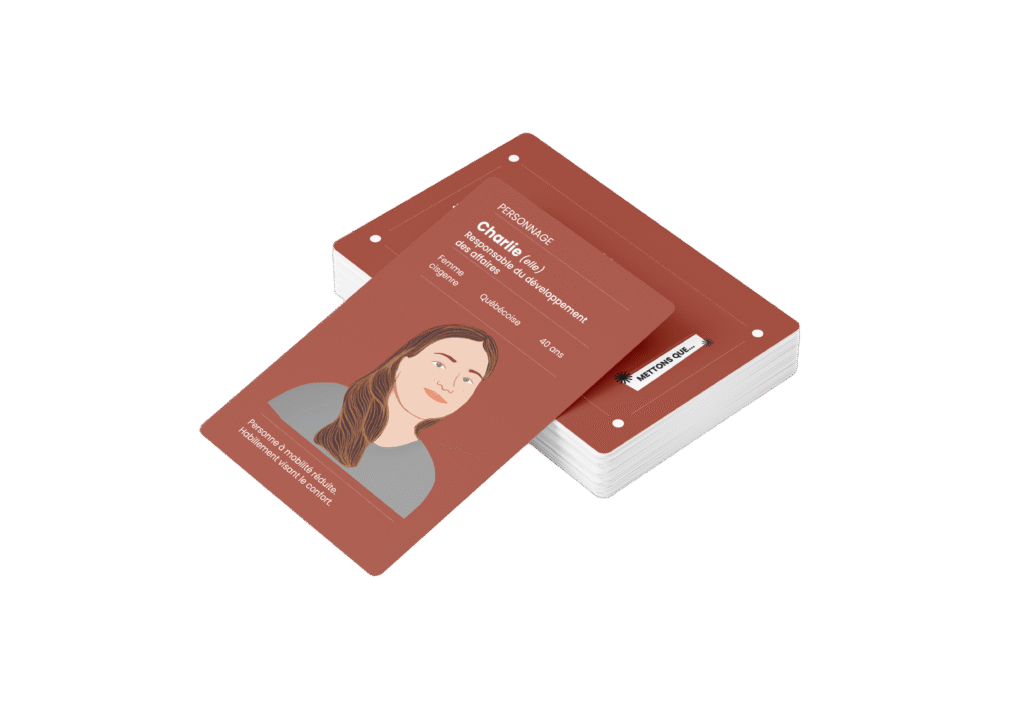
Want to generate constructive discussions within your teams?
The DEI card game “Mettons que…” is for you!
Each card features a character rooted in a diverse identity that we should reflect on.